
That Hideous Deicide
Wanting to Kill God is Very Bad News...


Who doesn’t love to complain about entertainment? It’s an unrecognized national pastime.
For example, this weekend, Steven Spielberg released another alien movie. He claimed it would undermine Christian faith everywhere. Spoiler alert: It didn’t.
In fact, most critics and audiences were underwhelmed.
Now I’m a big fan of Spielberg’s classic stuff – I actually used to work under him (full story here) – but Spielberg is certainly not a theist and never has been. That’s not news.
Most likely, this whole story was merely clickbait created by studio marketers concerned that Spielberg’s movie had low initial public awareness, and so they wanted to jolt it into the cultural conversation overnight. (Their ragebait actually succeeded in this, as the movie slightly over-performed its original forecasts.)
So if Spielberg’s quote was par for the course of our ragebait culture, then that’s not to say that there are not artists whose entire goal is to deconstruct faith, and actively reconstruct another worldview in its place.
But before I get there, let’s go back to our national pastime of complaining about entertainment. There have been a lot of folks complaining about the series-ending episode of Amazon’s streaming show Good Omens last month. The consensus online is that the series finale was profoundly disappointing. Yet, despite how unsatisfying it was to fans, it also represents a red flag for something other than inadequate storytelling. (FYI, I’m going to spoil that ending of Good Omens so SPOILER ALERT.)
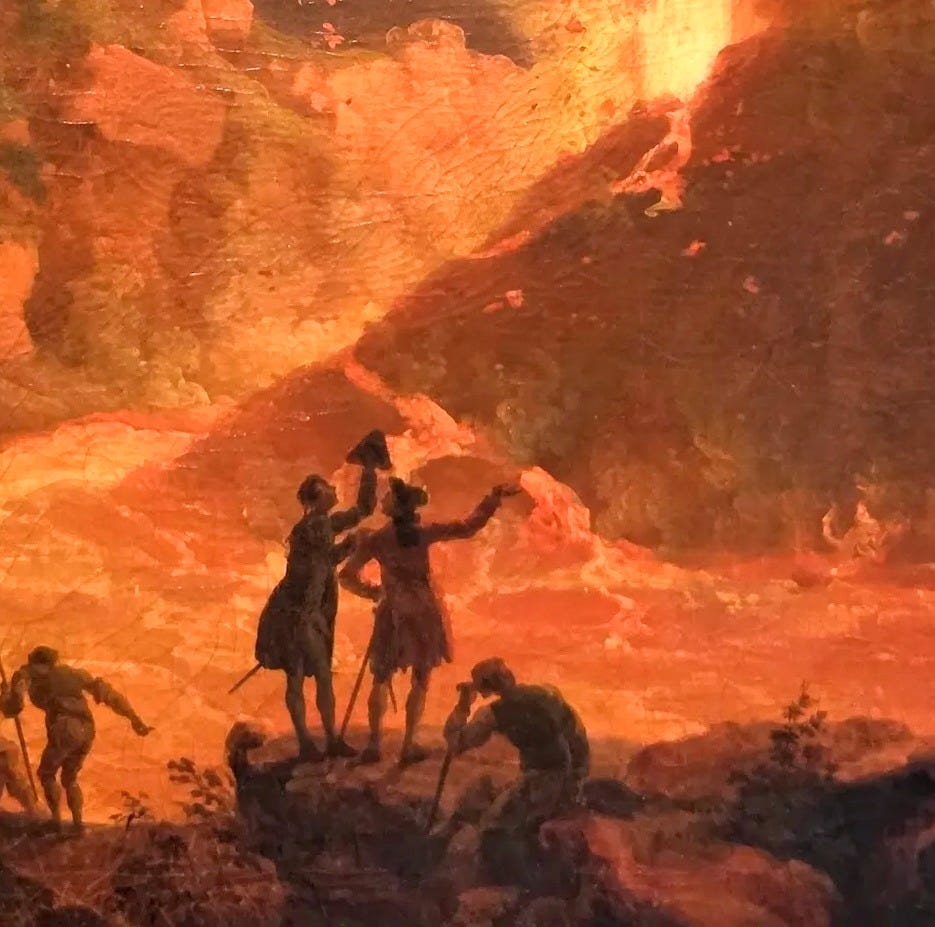
I’m not just engaging in our national pastime of complaining about entertainment here. It’s historically well established that when a culture’s fictional narratives shift dramatically, it’s always presaging and exposing a culture’s shifting hopes and dreams. For one example out of thousands, Shakespeare wrote Julius Caesar as an exploration of the morality of removing a tyrannical king one generation before the English civil war did exactly that. I don’t have time to prove this point with a thousand examples, but suffice it to say that it is very significant that a brand new literary subgenre has lately emerged: the subgenre of humankind defeating and killing God.
And in this subgenre, that’s not a tragedy, it’s meant to be a good thing.
I’m naming this subgenre the literature of deicide from Latin deus ‘god’ + -cide ‘to kill’. And, yes, * SPOILER ALERT * Good Omens ends by killing God, the two angelic protagonists annihilate their universe and in so doing create a new universe where there is no God (which is apparently supposed to be our universe).
And this ending is apparently supposed to leave the viewer overflowing with optimism. It’s meant to evoke the same blind, magical optimism of John Lennon’s Imagine lyrics: “Imagine there’s no heaven, it’s easy if you try…”
Ecclesiastes is correct. There really is nothing new under the sun and this brand-new subgenre of literature is, in a sense, very very old. It is a trope in several ancient pagan mythologies where heroes slay the gods and create new universes out of their carcasses.
However, in the history of Western Literature this emerging deicide subgenre is entirely new. Yes, it does have some deeper roots that we explored before, but this deicide subgenre is a brand new iteration, and therefore very disturbing because of what it might presage.
In 1990, Good Omens, was published.
To be fair, parts of the book are pretty funny (and that’s mostly the work of the ingenious Terry Pratchett who cowrote it with Neil Gaiman).
It’s always hard to know which influence is which in a writing partnership, but in this case it is knowable, because Terry Pratchett died, and then Gaiman promptly sold the rights of his book to Amazon. To expand the book for Amazon’s TV show needs, Gaiman wrote new stuff. His new stuff expanded and intensified all the themes of “deicide.”
In the original book, Gaiman and Pratchett didn’t really deviate all that much from the Promethean model of the 19th century. Their one twist? The angels are successful at thwarting God. In the end, the apocalypse is called off, and a character named Adam successfully steals apples from a tree owned by his grumpy father who is unsuccessful in his punishment of our plucky hero.
Okay, so this marks a definite shift in genre. We’ve taken the old myth of Promethean nobility and added a 20th Century technological optimism and defiance. This is new.

Kevin Smith’s Dogma (released in 1999 but written much earlier) features well-meaning but fallen angels who accidentally bring about the apocalypse because they’re just homesick and sad. Here God, or Alanis Morissette (ironic, don’t you think?), is simply absent-minded, not morally evil. She is confused and flighty. So our moral center is provided by Bethany, an abortionist who is the last direct heir of Jesus.
Here, God is again in the dock, but Kevin Smith decides to politely correct God but then leave “her” alive.
Kevin Smith and Terry Pratchett were both inspired by Robert Heinlein’s lesser-known 1984 book “Job: A Comedy of Justice.” In this story, Heinlein veers away from his normal science fiction and off into the multiverse as a mechanism to dream up happy endings for moral men who defy an immoral deity. Along the way he also spoofs Paradise Lost.
So by the 1980’s and 90’s with Pratchett, Smith, Heinlein and others, we’ve reached another evolution in genre. We’ve taken Lord Byron’s sad wandering, nobly failed Byronic heroes and added in a 20th Century optimistic slant. In this take, Prometheus wins. Our Promethean heroes successfully set up heavenly democracy whereby a moral humanity teaches an immoral God a lesson.
However, in these narratives, the suitably rebuked God doesn’t have to die… not yet. But rest assured, dear reader, that shift is coming. There is a pattern to these genre devolutions that cannot be stopped.
You can next look at the His Dark Materials trilogy by Phillip Pullman (1995-2000). The title is pulled from John Milton’s Paradise Lost, with Pullman appealing back to William Blake’s famous inversion of Milton.
This devolution of genre was absolutely intentional. In every single interview, Phillip Pullman cannot help but seethe out hatred for all things C.S. Lewis. In fact, he explicitly wrote his trilogy as the anti-Narnia.
Ultimately, his Promethean heroes succeed in deconstructing the evil church of his narrative and then dethroning the tyrannical usurper god Metatron and freeing the true God from his bottle, but in so doing they accidentally kill him.
Whoops! But then again, it’s no big deal as they soon set about creating a much more moral heavenly democracy, and everyone lives happily ever after.
And now finally the deicide subgenre has come into its own. Here humanity not only corrects God. Humanity kills God, and that’s a good thing.
In the old Promethean genre, God is evil, and man is good. But God is still strong, and man is weak. In the new deicide subgenre, God is evil but now very weak, and mankind is very moral and due to that morality they must kill off God.
After all, it’s the only moral thing to do.
Pullman’s trilogy is a seachange. His baseline is the Promethean rebellion, and then he adds another ancient layer (knowingly or not) as he pulls in the ancient heresies of Marcionism and Gnosticism. Marcion thought that the good god (Jesus) was being held captive by the bad god (Yahweh). Gnostics believed that through our own spiritual prowess we could attain to godhood, and correct cosmic abuses.
In Gnosticism, Jesus was a guide, not a god.
Phillip Pullman was intending to get this story in the hands of kids. However, he expected adults to fight back a bit. He was reportedly shocked at how little resistance he received for his trilogy. In fact, the trilogy was lauded as great stuff by none other than Archbishop of Canterbury, Rowan Williams, who had Pullman’s books read in religious education classes! (Pullman was reportedly confused.)
And isn’t it ironic, that Phillip Pullman makes Oxford the center for all of his deicidal heroes? He’s retelling the same story as C.S. Lewis’ That Hideous Strength but with the roles reversed. The deicidal scientists of N.I.C.E. are the heroes of this story.
This is the version of the story where the Tower of Babel reaches the heavens, topples God, and enthrones humanity.
That’s a new one.
Or rather, that’s a very, very old one.
If you believe I am hyperventilating, or inventing this out of thin air here is an Atlantic article of 2025 entitled: “Philip Pullman’s Anti-Escapist Fantasy.” The subheading reads: “In his fiction, the author of The Golden Compass tells us how to love this world. It isn’t easy.” The article marks the conclusion of release of the final book in Pullman’s second trilogy called “The Book of Dust.” The article outlines everything I do in this article, but it takes the position that this is a necessary subgenre for our current world.
In fact, there’s been a great deal of investment to try magnify the cultural impact of Pullman’s books. They have been adapted by BBC radio. They have been adapted for several staged plays run in theaters worldwide. There was a big-budget movie several years back and also there was the more recent big budget HBO series.
However, none of these have been successful.
Something about this deicide subgenre simply hasn’t captured the imagination of the public at large, and most of these adaptations have lost money.
So thankfully, this emerging subgenre remains a subgenre, a genre that hasn’t yet broken out into the majority.
However, last month, Amazon’s Good Omens tried to advance the deicide genre one step further beyond Pullman’s previous high water mark. But again, even atheists were displeased with how Neil Gaiman rewrote his own ending.
We all know in our guts that deicide just doesn’t work. It is true that many choose to suppress that knowledge, à la Romans 1, but when entertainment tries to popularize deicide… well, to most of us, it just feels… nonsensical and unsatisfying.
And it has to be said that the creators behind this new movement in literature, are far more optimistic than the philosophies of their allied thinkers.
Almost everyone knows that Freidrich Nietzsche wrote that ‘God is Dead’ but not enough people know the full quote of the character who says the famous line.
Here’s the full quote:
“God is dead. God remains dead. And we have killed him. How shall we comfort ourselves, the murderers of all murderers? What was holiest and mightiest of all that the world has yet owned has bled to death under our knives: who will wipe this blood off us? What water is there for us to clean ourselves? What festivals of atonement, what sacred games shall we have to invent? Is not the greatness of this deed too great for us?
Must we ourselves not become gods simply to appear worthy of it?”
Even the arch-atheist Nietzsche had to engage with the glaringly obvious question that these recent artists are intentionally avoiding. If God is dead, what does that mean?
Does it mean rivers of chocolate and rainbow and dancing happy children and a mankind who finally free?
No.
According to Nietzsche the so-called “death of God” means a terrifying reckoning, and an unavoidable power vacuum. Any usurper of God’s throne will feel the crushing weight and responsibility of deity. And even Nietzsche understands that this is a weight that no human can bear.
Nietzsche’s solution was to hope for a new evolution, a new “superman” who could finally bear this weight which was unbearable by homo sapiens as he knew it. Nietzsche avoided madness by his conjecture that perhaps at some indeterminate time in the future some übermensch (usually translated into English as “Superman”) might arise and evolve, a being that could finally handle this kind of weight.
In 1933, a certain Nietzsche fan boy and frustrated artist in Germany decided he would help out with that project. He tried to achieve the superman but (thank God!), he ultimately failed. However, he did start World War 2.
In 2026, apparently we’ve decided to try, try again. Sadly, this deicide subgenre extends to all of the arts, not just literature and film.
I’ve already explored elsewhere how John Lennon musically expanded this deicide subgenre in songs like “Imagine” and space doesn’t really allow for explorations of all the various entries in this subgenre, like The Good Place (2016-2020), Childhood’s End (1953), The Library at Mount Char (2015), Imajica (1991) or the many comic book series of Preacher, Sandman and Spawn.
There are lots of other examples
However, it’s admittedly not a huge subgenre. Not yet, but it is growing…
In His Dark Materials after our heroes successfully kill god, they then set up a ‘republic of heaven’, which is nothing more than what pastor/author Mark Sayers has previously dubbed “the Kingdom without the king.”
After all, who needs the actual Kingdom of God when you can replace it with all the benefits of the Kingdom without the rulership of King Jesus?
This new genre of deicide promises all the benefits without the benefactor. Deicidists say that in the near future, we will somehow achieve all the blessings without the blesser. The future is the key; we will “progress” to the ultimately utopian future.
All heresies must borrow certain premises from the truth that they twist.
Both Christians and deicidal creators place their hopes in a brighter future.
The deicidist believes that somehow, magical and vaguely defined forces will somehow shape the future into a kingdom very similar to the one that Christ promises. (For folks like Spielberg, the vague force that shapes the future into utopia is aliens.)
Mankind has always coveted that vision of a future heavenly era on earth, but they refuse Christ’s assessment of the deeper problems inherent in humanity. They seek a different solution.
Christians are the realists here. We see the depth of the problem. It is so deep that humanity can sometimes even believe that deicide is a good thing. It is so profound that mankind can believe they’re the good guys and God himself is the bad guy.
We Christians believe that the universe was breathed into being by an ineffable power and personality beyond all conception. We further believe that only that God is powerful enough to solve this incredibly deep problem. Only God can heal this fallen world.
We Christians are able to correctly assess the deep darkness of the darkness of mankind. For us, the problem isn’t a social foible or a phobia or guilt complex to be overcome. We say that sin is a fundamental misalignment that was started on purpose by humanity. Sin is like a planet willing itself out of its orbit, without understanding that it now must either hurtle into the sun it orbits or hurl itself out into outer darkness. The misalignment of sin will ultimately burn up everything, and any future without God is cold outer darkness.
Deicidists claim that sin is imaginary, and they rename the primal problem as hierarchy and authority. If you were to topple all hierarchies, all the way up to the top, then the future would be fundamentally good.
The lie is as old as Satan, but its current formulation was inspired by the modern founder of political anarchism: an ill-humored Russian atheist named Mikhail Bakunin.
Bakunin famously said, “If God really existed, it would be necessary to abolish him.”
(Bakunin was also famously frenemies with Karl Marx, though they agreed on this point.)
A wiser voice of the next generation, G.K. Chesterton countered anarchist claims by explaining that sin is the one aspect of Christian theology that can be proved by any front page headline, at any time in history.
Sin is just an empirical fact. It doesn’t come from systems. It doesn’t have anything to do with systemic hierarchies (except in the sense that humans run them).
Sin comes from the human heart itself.
Another crotchety old Russian correctly analyzed what Bakunin misunderstood. Aleksandr Solzhenitsyn wrote: “The line separating good and evil passes not through states, nor between classes, nor between political parties either -- but right through every human heart -- and through all human hearts.”
This truth of human nature is deeply offensive to all of those who place great optimism in the future. After all, the problem has to be small in order to be solvable by the future.
As C.S. Lewis wrote, idealists “think of the Future as a promised land which favored heroes attain… not as something which everyone reaches at the rate of sixty minutes an hour, whatever he does, whoever he is.”
Deicidists believe that somehow, in some vague way, the bright future will somehow just magically heal human nature. Somehow progress through time will bring about the desired millennial era, because of some mumbo-jumbo about empathy and inevitable evolution. And it is precisely that unfounded optimism that is the root of the subgenre of deicide.
Yes, some believe we can force a better future by sheer willpower.
Do 👏 The 👏 Work!
Be 👏 Better! 👏
Believe 👏 in 👏 humanity!
Nietzsche called this willful optimism “the will to power.” He claimed this was the main driving force in all humans and the main agent by which the desired good future will finally come about. Mankind just has to will it hard enough, and soon they will ultimately triumph.
We Christians disagree. We are far more fundamentally pessimistic about what the problem of mankind is. Because of this, we say that the kingdom can only come by the work of the true king. Only Jesus can solve a problem so deep, we may never fully understand its depths.
“Okay, Sam,” you say. “That’s an interesting concatenation of various historical facts and random literary criticism. But I was never going to watch Good Omens and I think Phillip Pullman is a rude jerk. Why should I care?”
That’s fair. But most folks weren’t big fans of Shelley or Blake or the Promethean authors of the 19th Century, but their bold rejection of God was a stark red flag for the historical realities of the 20th Century that impacted everyone, everywhere. Their Promethean subgenre presaged what was to come.
So if past red flags in literature have accurately predicted various upcoming changes in culture, then what does the emergence of this new-old genre mean for all of us?
To return all the way back to That Hideous Strength, in it C.S. Lewis wrote that:
“Those who call for Nonsense will find that it comes.”
Nietzsche’s will to power is nonsense. Bakunin’s identification of authority as the primal sin is nonsense. The claim that you could ever kill the foundation stone of reality is pure nonsense.
And yet… growing swaths of mankind desperately want to believe that nonsense. God’s nudges, hints, pokes and warnings keep threatening to destroy the tower of Babel that humanity is always sacrificing everything to finally complete.
Some of these folks are answering that threat (at least in fiction) by saying: Let’s kill God! (For this substack, I’ve kept my focus tight on literature and creativity, but this impulse also pervades politics, AI and can be found all over modern culture.)
It means something that deicide is no longer hidden in the darkest corners of mankind’s soul but now marched proudly out into the light. Lucifer’s ancient nonsense desire, to kill God and take his throne, is openly being openly touted as the epitome of all human progress.
It means that the fictional world of That Hideous Strength is no longer a fiction.
It is upon us.
I wrote an initial piece about C.S. Lewis warning us via his novel That Hideous Strength
Then a second essay about the anti-God genre of Romantic poets.
This essay completes those other two.

"If you dip into any… history, you always find that there was a time before that point when… contrasts weren't quite so sharp; and that there's going to be a time after that point when there is even less room for indecision and choices are even more momentous. Good is always getting better and bad is always getting worse: the possibilities of even apparent neutrality are always diminishing.”
C.S. Lewis, That Hideous Strength

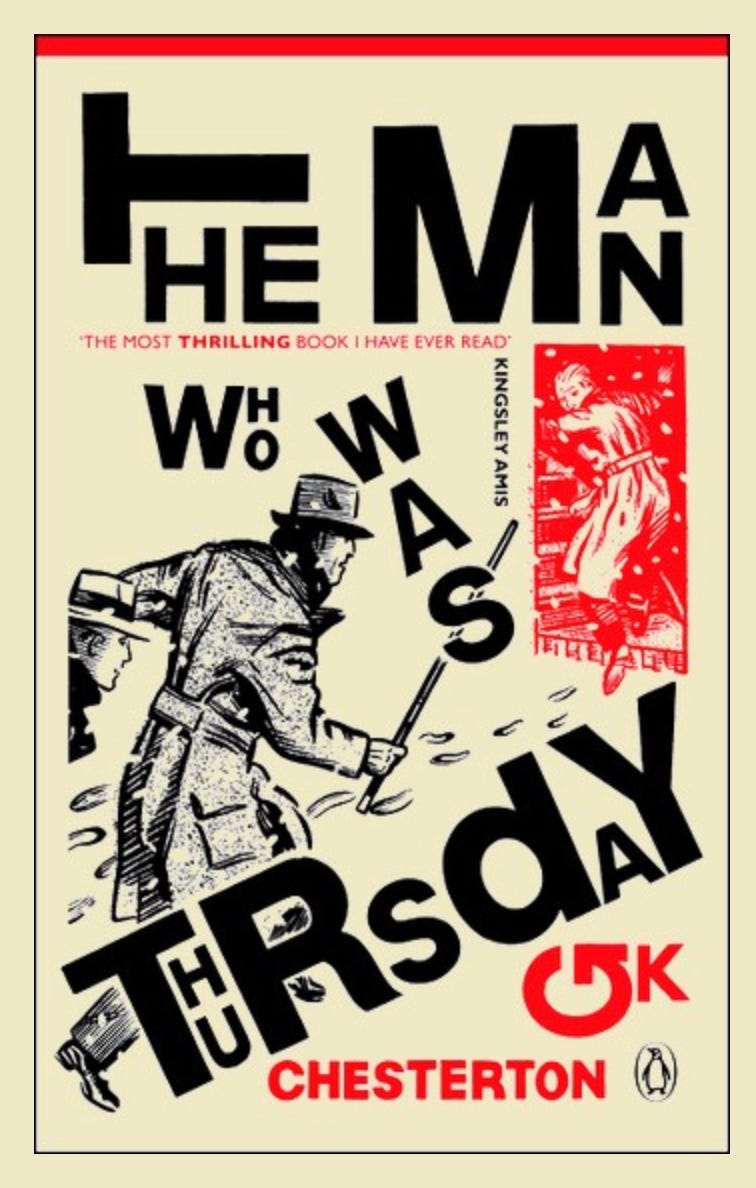
Before the deicide genre had even fully emerged, G.K. Chesterton anticipated all their arguments and responded to them beautifully in his masterpiece novel, The Man Who Was Thursday.
Chesterton never claimed to be a prophet, but he could read the handwriting on the wall better than any other commentator of his era, and he could take a few more imaginative steps forward and accurately anticipate exactly where we find ourselves in 2026.
Chesterton, in this novel, writes out a perfect rebuttal to the subgenre of deicide, in an intricate plot filled with mystery, intrigue, imagination and even humorous pratfalls. Seriously, this melding of genres really shouldn’t work, yet somehow it completely does. That’s why The Man Who Was Thursday is one of my top 5 novels of all time. If you haven’t read it, I recommend it highly.
Chesterton presents humanity’s darkness very clearly (very similarly to what I have argued in this essay). But then he also bursts through at the end of the book with the light.
And if you’re discouraged, don’t be! Christ was clear that the darkness must steadily get darker, but one day He will appear to be the Light that obliterates forever all the darkness! In this book, Chesterton reminds of that fact with all of his characteristic wit.
 | A guest post by
|
Fascinating read.
Love so much of this. A bunch of these gems -
"Christians are the realists here. We see the depth of the problem. It is so deep that humanity can sometimes even believe that deicide is a good thing. It is so profound that mankind can believe they’re the good guys and God himself is the bad guy."