
That Hideous Oxford
Why C.S. Lewis loved Oxford and also sought to warn the world about it


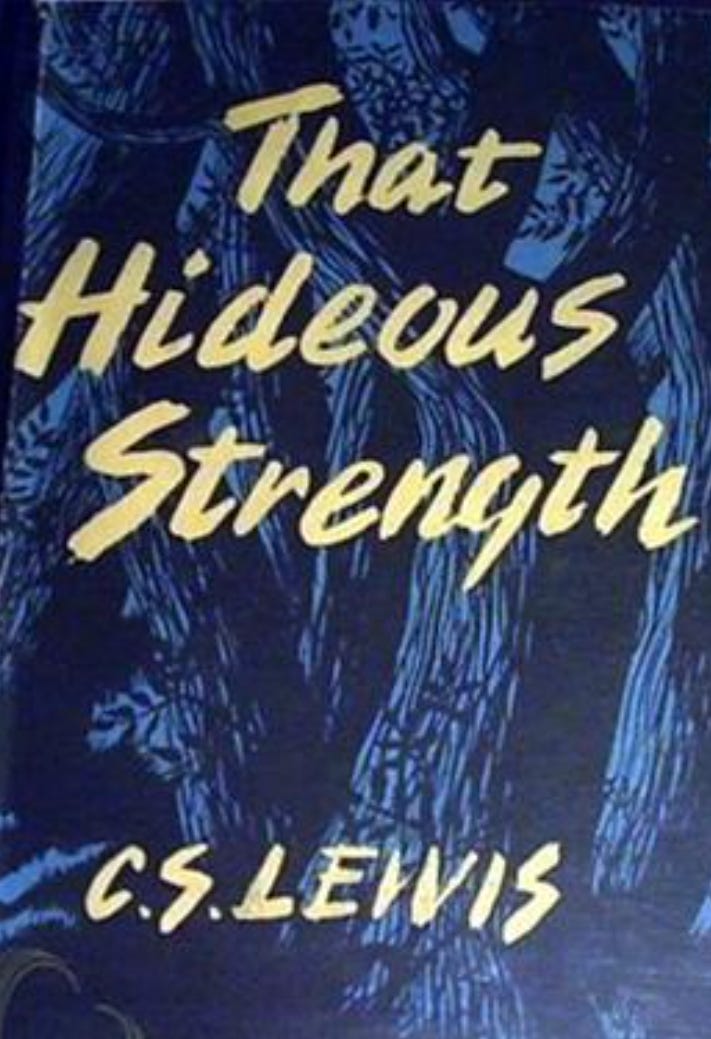
The title of C.S. Lewis’ novel, That Hideous Strength is taken from a 16th century poem about the Tower of Babel. Lewis chose that title on purpose, because we read in the Bible that the project of the Tower of Babel was abandoned unfinished.
Lewis wants us to know that there are those who are very eagerly trying to complete that tower. These folks don’t announce themselves. They’re not looking for fame, or to be known by you. They’re seeking something else. These men and women burrow themselves inside academia, inside bureaucracy and inside science. Lewis met many of these men in Oxford. He doesn’t call them out by name but he does call them out in a literary Jeremiad.
More than sci-fi or fantasy, That Hideous Strength is a warning by a man who has been in the backrooms of academia and wants to warn the reader what he’s seen.
Besides, if Lewis gave names, you probably wouldn’t know those names. These are the folks who don’t want you to know who they are. They aren’t about the fame, only the control. They want you to think they’re nice.
That’s the joke of C.S. Lewis’ bureaucratic acronym N.I.C.E. in That Hideous Strength. N.I.C.E. is the shell organization of the folks who are ardently trying to finish the job of building the Tower of Babel.
Lewis is making a joke here, but he’s also deadly serious. Those who are working to reestablish the unfinished business of the Tower of Babel will never tell you what they’re doing. They won’t present themselves as evil. They will present themselves as NICE, or “as an angel of light” and so deceive many.
I mean who would be so paranoid to suspect evil inside a perfectly legitimate bureaucratic institution tasked with the betterment and flourishing of all mankind? Can’t you tell from the name that they’re really nice? It says so in the name!
Lewis published the book in 1945, but he set it in 1948. George Orwell reviewed the book and found it intriguing (though he immediately dismissed all the Christian elements). Orwell took a stab at a similar warning to Lewis, publishing it in 1948, only he reversed the last two digits to make it 1984.1
Yes, even a cynical atheist like Orwell could see the truth in Lewis’ warning.

Lewis spent most of his life in Oxford, among the most gifted, educated and elite of an entire generation. Folks tell writers to write what they know. Many writers follow that advice.
C.S. Lewis did it only did it once. He tended to avoid mentioning Oxford in his fiction or his nonfiction. In fact, academia and Oxford are very conspicuous by their absence.
Why?
Because I believe Lewis felt that was the most charitable reaction to the world he waded through every day. It was a kindness that Lewis rarely delved deep into Oxford in any of his fiction.
I believe Lewis was proud to be English and honored to work at Oxford. But he also knew something else deep, deep in his bones but he didn’t know quite how to tell the rest of the world about it.
But during the darkest days of World War II, after seeing what small seeds could grow into given enough time and space. Lewis finally decided he needed to warn the rest of us about what he saw. And he chose to do it in the form of a sci-fi parable.
After all, the college in That Hideous Strength is pointedly NOT Oxford. This purely invented college is explicitly said to have outcompeted Oxford to become home to N.I.C.E.
Lewis is being a little coy here, and winking at the reader like a cheeky kid. Yes, of course, I never meant for this college to be Oxford. This could never happen at Oxford. Oxford would never be the center of a new worldwide push for the Tower of Babel after World War II. No, never never never! Perish the thought!
Wink. Wink. Nudge. Nudge.
But Lewis looked at the world in mid-World War II and he knew Oxford and England was both fighting for the side of good, and also very responsible for the evil too. Lewis knew that the seeds for the philosophic underpinnings of fascism, eugenics, anti-Semitism and the scientific excuses for mass murder, those all had their roots in universities like Oxford. Lewis also looked over at the looming threat of the Soviet Union with its separate excuses for mass murder, its glorified revolution, its communist utopian vision based on garbled so-called science and he knew that all those too had their roots in universities just like Oxford.
The best argument that Lewis can extend for his colleagues in Oxford is that they’re so buried in their ivory towers that many of them don’t understand their influence. Lewis makes this clear in the mouth of one of his fictional professors in the last chapter of the book: “They never thought anyone would act on their theories! No one was more astonished than they when what they’d been talking of for years suddenly took on reality.”
So yes, of course, Bracton College is meant to represent Magdalen College. And Edgestow is meant to represent Oxford. Lewis uses the thinest of veils here. He’s writing about Oxford. He’s using parable to describe to us things that he’s witnessed with his own eyes. He’s warning us in literary code, because he’s saying N.I.C.E. isn’t only a real thing, but that you’re reading about it every day in your newspaper (this was back in the time when newspapers were a thing).
Lewis is saying that Oxford (and academia) bears a great deal of guilt for World War II and the future (for him) Cold War. Lewis is also arguing explicitly that academia will be a key component in bringing about the end times disasters of Revelation. Lewis is being slightly coy (he did want to keep his job in Oxford after all!) but he does want the reader to realize that this is really happening, right now, right under your noses.
As Lewis writes in the novel: “Those who call for Nonsense will find that it comes.”
What nonsense you ask? In the novel, under the guise of fiction, Lewis gives us all a quick primer on how government interference, greed and revolutionary ideologies can easily hijack a tenure committee. Also, under the guise of plot development, Lewis also shows in great detail how propaganda works. He puts us into the headspace of the type of people who are both witting and unwitting pawns in the propaganda wars that rage just below the surface.
Lewis explicitly cites the idea of Trahison des clercs in the novel. Trahison des clercs is the French title of a book well known in Lewis’ era. Translated it means: treason of the intellectuals.
Lewis can look around at the suffering of World War II and know that his profession and his university bore much of the blame for birthing these strange nonsense ideologies into the world. And once these ideas were birthed, look at the devastation they brought!
But what makes this all tick? What is the root sin of Oxford?
It’s all pretty simple stuff dressed up in impenetrable elevated language. It is the old story of greed, ambition, pride and lust for power. That’s what makes these incredibly intelligent people into the unwitting foot soldiers in a war that most don’t even understand. They’re simply fighting their way up the ladder. They don’t get what they’re really doing, and honestly they’re so spoiled and contented, they don’t even really care. They can rattle off all sorts of great sounding patter of helping humanity, compassion, empathy… but it’s all a show. It’s all a pretty lie.
Lewis tells us that Oxford runs on greed, advancement and fear of looking foolish in the eyes of one’s peers.
More succinctly, what drives Oxford (and all of us) is what Lewis calls the love of the inner circle. Lewis writes: “Of all the passions, the passion for the Inner Ring is most skillful in making a man who is not yet a very bad man do very bad things.”
Yes, as Lewis terms it, it is the “desire to be inside the invisible line” that drives most academics, most propagandists, and the functionaries of most governments. But it’s a losing game. “As long as you are governed by that desire you will never get what you want. You are trying to peel an onion: if you succeed there will be nothing left. Until you conquer the fear of being an outsider, an outsider you will remain… The circle cannot have from within the charm it had from outside. By the very act of admitting you it has lost its magic.”
Groucho Marx once said that he would never want to be a part of any club that would have him for a member. That’s sort of the flip side of what Lewis is warning us all about. Truly, if you lust to be in an inner ring, once you achieve it, the lust only intensifies.
Lewis writes: “Once the first novelty is worn off, the members of this circle will be no more interesting than your old friends. Why should they be? You were not looking for virtue or kindness or loyalty or humour or learning or wit or any of the things that can really be enjoyed. You merely wanted to be “in.” And that is a pleasure that cannot last… The rainbow’s end will still be ahead of you. The old ring will now be only the drab background for your endeavor to enter the new one.”
This is what Lewis is showing us in his novel. You may never have visited Oxford, but you already know it very well. You also have an inner ring where you work, where you study, in your neighborhood. Have you ever wanted to get inside of it?
Congratulations, you too, could be used as a pawn of the new Tower of Babel (currently under construction).
That’s Lewis’ warning to you and to me.
The architects of the new Tower of Babel are using new technology to harness very old human psychology. They know you want to be one of the smart ones, one of the successful ones, one of the good ones, one of the inner ring. These architects already know you might just be willing throw other people under the bus to get inside that inner ring.
In fact, they’re counting on it.
Because the architect of the new Tower of Babel is the same one who made the first one. No, it wasn’t Nimrod, Lewis says, no it was a power much darker, more sinister. A power that understands your lusts to get inside the inner ring. A power that wants you not to realize what you’re really doing, and focus in only on your ambitions, your pride and your own ego.
That way, you’re a much more reliable foot soldier. That way you’ll fight hard, still ignorant of the real war you’re fighting in.
Because who was at the center of N.I.C.E.? What was at the center of Edgestow? (Not at the center of Oxford! Wink, wink, nudge, nudge.)
In the book it is demonic powers.
Yes, when C.S. Lewis looked at what was happening in Oxford of his day, he saw Satan coiled up under the foundation, pulling each and every lever by means of a simple trick: the power of the Inner Ring.
This was in 1945. This was after a war against the Nazis. This was at the beginning of a war against Communists. And as Lewis looked at the roots of the Nazis, when he looked at the revolutions in Russia… he saw that same coiled up power underneath it all. Then he looked at Oxford and underneath the beautiful architecture, and the supposed smart people, Lewis saw that same coiled up dragon, using the exact same strategy.
Yes, Lewis saw it, even 80 years ago, he saw that the great dragon is slowly rebuilding his tower against heaven, brick by brick, and he’s using a very simple trick that always seems to work on everyone, especially on the “best and brightest” and the “most educated” of any society.
So C.S. Lewis has a question for you:
What would YOU do to get into that inner ring?

“Unless you take measures to prevent it, this desire is going to be one of the chief motives of your life, from the first day on which you enter your profession until the day when you are too old to care… if you drift with the stream, you will in fact be an “inner ringer.” I don’t say you’ll be a successful one; that’s as may be. But whether by pining and moping outside Rings that you can never enter, or by passing triumphantly further and further in—one way or the other you will be that kind of man.”
⁃ C.S. Lewis

It’s tough to get through the first few chapters of this novel. It is dense! (Lewis recreates the stuffy and stilted environment of 1940’s Oxford a little too accurately) However, if you can muscle through, you will find that this might be C.S. Lewis’ most prescient gospel warning that he left to later generations. Yes, Orwell’s reply to it (1984) is a more famous warning, but this one has far more meaning for a Christian. Because while Orwell vividly presents the power and evil of this new Tower of Babel, he cynically dismisses Lewis’ antidote.
Lewis is adamant that this is fundamentally a spiritual war. And Lewis is correct.
Technically published in 1949, but written in 1948... See, it even took Orwell a year to publish his stuff!
 | A guest post by
|
Thank you for this. I have felt the lure of the inner ring many times. I've never thought about the fact that an inner ring loses its mysterious draw as soon as you enter. That is so true.
It's the same motivation that drove Satan himself, so he expects everyone else to want to do the same.