
That Hideous Prometheus
The anti-God legacy of the Romantic Poets


Mary Shelley was a literary genius who was also married to another literary genius: Percy Bysshe Shelley.
But genius only means fantastically gifted, not incredibly wise.
Percy Bysshe Shelley hated God, and he sought out other literary forebears for his loud and proud atheism, but to his great frustration, he could find very few. Even his wife couldn’t quite pull the trigger on her own atheistic allyship.
Frankenstein: The Modern Prometheus warns of the dangers of mankind playing God, not of the joys. True, one could argue (and many have) that the novel Frankenstein is actually trying to make Adam’s case against God. Is Frankenstein’s monster more moral than his creator? It’s a debatable point. Mary Shelley was well steeped in the Promethean mythos of the creature being more moral than the creator, yet even so it is hard to argue that Frankenstein’s monster is really the good guy.
Perhaps poor poet Percy was perilously unprofitable in his primary pursuit of a poetical predecessor, however, he did have a handful of allies in his own time. Johann Wolfgang von Goethe had written a very famous misotheist work called Prometheus that was published during the French Revolution. Mopey Goethe championed the noble, but doomed, Prometheus* who was far more moral than the gods, but far less powerful.
(*Prometheus is the myth of the titan that stole fire from the gods to benefit mankind. For his generosity to man, he was doomed to continuous torture. However, the structure of the myth presupposes that Prometheus is moral, and the gods immoral. That was its appeal.)
Percy Shelley liked Goethe’s work so much that he wrote his own work titled Prometheus, published in 1820.
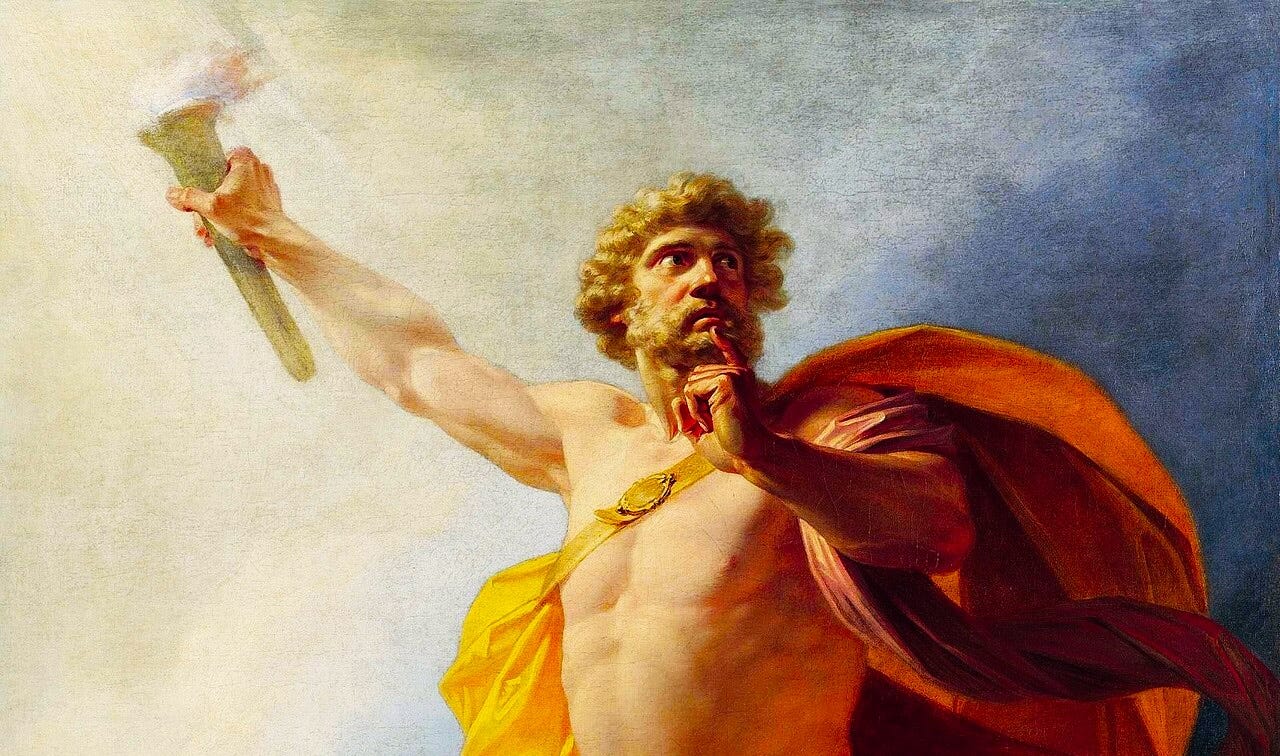
In his pursuit of a literary ancestor, Percy Shelley liked to cite William Blake’s dictum that John Milton was “of the Devil’s party without knowing it.” Yes, Satan does fit the role of the epic hero in Paradise Lost but many literary scholars (C.S. Lewis foremost among them) will tell you that Milton did this on purpose to subvert the genre, not to actually argue that Satan was the good guy. But in an era that idolized Prometheus, they looked to Paradise Lost and couldn’t help but identify Lucifer as a Promethean character. Long dead John Milton had assumed that his audience would understand that Satan’s incredible egotism and his willingness to destroy the entire world to enact his vengeance would clearly mark him off as, you know, the bad guy.
However, in the wake of the French Revolution, Europe was filled to bursting with egotistical leaders willing to implode the world (in order to rebuild their vision of utopia) and thus Blake’s minority reading of Milton became incredibly influential. Everyone likes to have a literary forebear.
Once William Blake had released this concept of a Promethean Satan out into the literary atmosphere then Goethe, Shelley and many others began to toy with it. Karl Marx even wrote a play titled Oulanem in which the titular Promethean hero rages how unjust it is that God should ultimately judge the earth, and so Oulanem decides to judge God first! (Oulanem was an intentional anagram of the messianic title of Emmanuel.) However, we will never know what happens at the climax of Oulanem because Marx never finished his play. Yes, much like Hitler, Marx was a frustrated, failed artist who turned to politics instead…
Later additions to Greek myth, decided to give Prometheus a happy ending. Some tales had him being rescued by Hercules. Yet in the 19th Century, these angry atheistic artists never gave a happy ending to their noble, yet doomed, Prometheus-characters. They unthinkingly respected the omnipotence of God, even as they attacked his goodness.
And they constantly attacked his goodness. For instance, Lord Byron was born to a harsh Calvinistic father who decided his son was one of the reprobate, born for hell. Byron understandably wasn’t a fan of that, so he intentionally looked to the Bible’s villains to find the model to create his famous Byronic hero.
The Byronic hero was primarily modeled on Cain. Lord Byron felt he found a kindred soul in Cain the ever-wanderer. Cain the brooding, and misunderstood anti-hero. Byron also copied from Milton’s brooding Satan in order to try to create the heroic anti-hero, now usually called the Byronic hero.
Is the hero mopey, misunderstood, dark, emotional and has a magnetic power over women? Yup, whether you know it or not, you’ve created a Byronic hero! Byronic heroes suddenly exploded all over literature in the 19th Century. Heathcliffe was obviously a Byronic hero. Mr. Rochester in Jane Eyre was partially a Byronic hero. Later, Cal Trask in East of Eden was definitely a Byronic hero. Then, James Dean was in the mold of the Byronic hero. Even silly, twinkly Edward the Vampire in Twilight carries second-hand echoes of the Byronic Hero…
For a time, Prometheus-types and Byronic heroes were the end of the story, but then things evolved.
John Milton anticipated this literary evolution in Book Two of Paradise Lost.
In that section, all the fallen angels seethe and rant about their failure to capture heaven or kill God. Satan sulks in Byronic fashion while the other archdemons argue their respective strategies: fight, flight or fake it.
First, the raging, furious soldier Moloch demands they go all back and attack heaven again. Yes, it is an impossible fight but why not go out in a blaze of glory? In his counsel, Moloch screams and shouts like a dragon. Here is the Promethean option, open rebellion, noble and courageous, though likely doomed.
When Moloch is done advancing the Promethean option, the charming, smooth, political Belial rises to address the demons and he advises that all of them should bide their time, reassess the situation and not compound the problem. He doesn’t call it hiding or running, he calls it wisdom. When his oily speech is finished, he slithers snake-like away.
This second option of Belial was advanced by a majority of the writers, politicians and academics of the late Victorian and Edwardian era. Make an uneasy peace with the foolish majority. Bide your time and seethe in secret. This was the strategy of men like Marx, who started as an angry Promethean spiritual revolutionary with his play Oulanem, but then shifted toward a loud and proud materialism, which smuggled in a lot of spiritual concepts through the backdoor. This was very common all throughout the west. Artists, politicians and others, ostensibly materialist, would keep their revolutionary spirituality deep in the closet.
In the poem, Satan quickly rejects this strategy.
So then the third arch-demon rises up: Mammon. He argues that the best path forward is to make hell into heaven. In short, his strategy is to just fake it.
In his “Preface to Paradise Lost,” C.S. Lewis tells us more:
“[Mammon] believes that Hell can be made into a substitute for Heaven. For everything that has been lost, you can find something else that will do quite as well. Heaven was magnificent: if Hell is made equally magnificent it must be just as good. There was light in Heaven: if we produce artificial light, it will be just as good… The human analogues are here the most obvious and the most terrible of all – the men who seem to have passed from Heaven to Hell and can’t see the difference. “What do you mean by saying we have lost love? There is an excellent brothel round the corner.”
…
Everything can be imitated, and the imitation will do just as well as the real thing.”
Mammon’s advice to his hideous Lord is to suggest that Hell could and should be forged into Sorta-Heaven. They could make their prison into a Temu-Paradise, and Satan could sit on a golden throne (made of tinsel).
In Milton’s narrative, Satan discounts Mammon’s advice and instead goes with this strategy of his next advisor, Beelzebub.
However, in 2026, it would appear that many artists are listening to Milton’s third demon and making it their new official strategy. It is now in vogue to argue that there’s no real difference between good or evil. We can and should just make evil into good. We can forge our own artificial conceptions into reality.
We can will the fake to be the same as the real.
I will address that newest artistic trend in my final essay…
I wrote an initial piece about C.S. Lewis warning us via his novel That Hideous Strength. This essay is related to that one, and there will be a third one after this one!

“The ancient man approached God (or even the gods) as the accused person approaches his judge. For the modern man, the roles are quite reversed. He is the judge: God is in the dock. He is quite a kindly judge; if God should have a reasonable defense for being the god who permits war, poverty, and disease, he is ready to listen to it. The trial may even end in God’s acquittal. But the important thing is that man is on the bench and God is in the dock.”
― C.S. Lewis, God in the Dock: Essays on Theology and Ethics

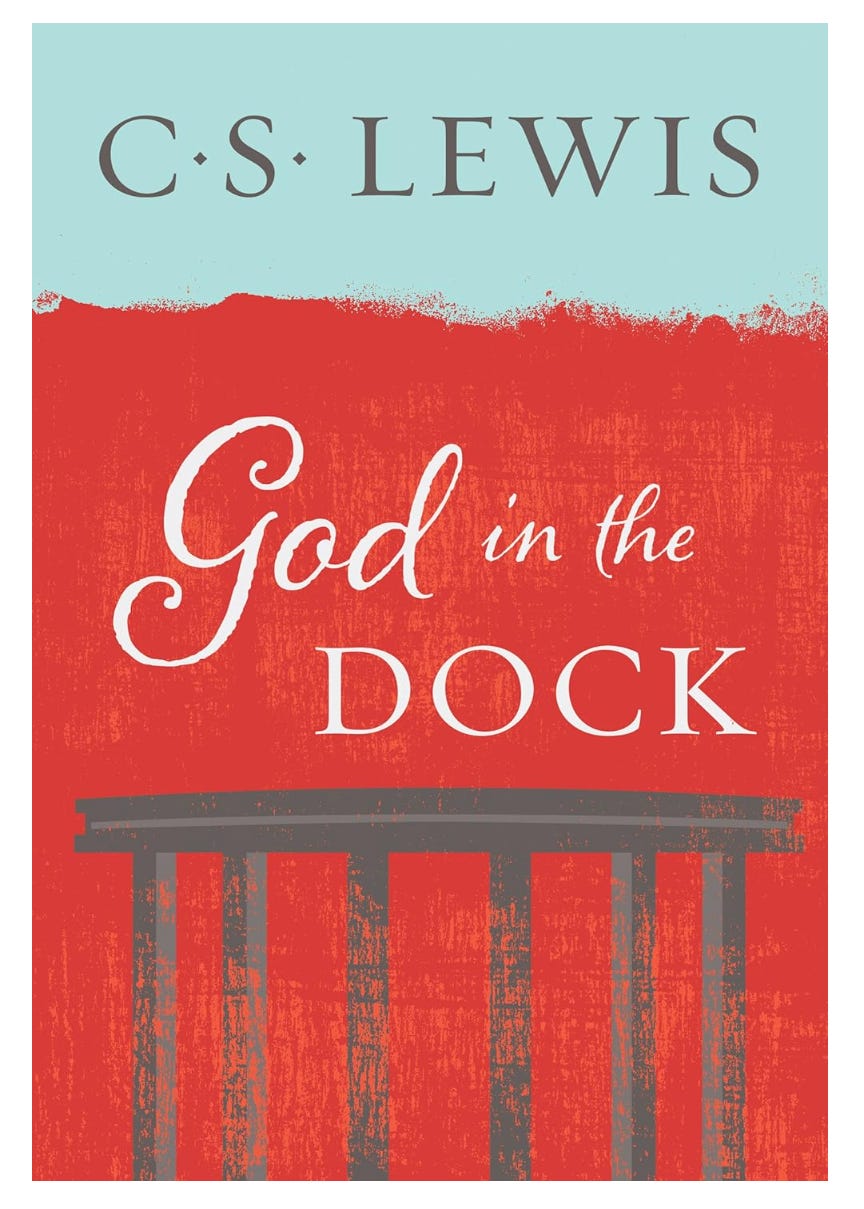
In British English, to be “in the dock” means to be under condemnation by the court. The man in the dock is being judged by the court. So if “God is in the dock” then Lewis says we’re getting it all backward. We’re making humanity the judge and God the defendant. So in his essay “God in the Dock” C.S. Lewis delves deeper into that idea. If you’ve never read it, I would definitely suggest getting a hold of a copy!
The parallels between the Romantic poets and their misreading of Milton are enlightening. I have a complicated view of Prometheus. I have found him to be pitiable while still acknowledging his hubris in going around the gods. As with so many “gifts” it harms as well as helps. It puts me in mind of the origins of the Nobel Peace prize. Someone intended only good and was horrified by the results.
Poetically speaking, Blake is correct, in that Milton does give Satan both the lion's share of the lines and arguably the best poetry in the poem. In a way, it acts somewhat opposite to the book of Job in which those brilliant ancient poets build the poetic structure in a way that gives God the most surprising and brilliant lines, with Job being a runner up, and his accusers's speeches riddled with stilted language and cliches except perhaps the ever controversial Elihu. Of course, Macbeth also gets brilliant lines too, and Shakespeare clearly didn't mean that even as the protagonist, that Macbeth should be held up as a model of heroism but rather like Macbeth reveals the logic of despair:
Me miserable! which way shall I fly
Infinite wrath, and infinite despair?
Which way I fly is Hell; myself am Hell;
And, in the lowest deep, a lower deep
Still threatening to devour me opens wide,
To which the Hell I suffer seems a Heaven.
O, then, at last relent: Is there no place
Left for repentance, none for pardon left?
None left but by submission; and that word
Disdain forbids me, and my dread of shame
Among the Spirits beneath, whom I seduced
With other promises and other vaunts
Than to submit, boasting I could subdue
The Omnipotent. Ay me! they little know
How dearly I abide that boast so vain,
Under what torments inwardly I groan,
While they adore me on the throne of Hell.
With diadem and scepter high advanced, 90
The lower still I fall, only supreme
In misery: Such joy ambition finds.
But say I could repent, and could obtain,
By act of grace, my former state; how soon
Would highth recall high thoughts, how soon unsay
What feigned submission swore? Ease would recant
Vows made in pain, as violent and void.
For never can true reconcilement grow,
Where wounds of deadly hate have pierced so deep:
Which would but lead me to a worse relapse
And heavier fall: so should I purchase dear
Short intermission bought with double smart.
This knows my Punisher; therefore as far
From granting he, as I from begging, peace;
All hope excluded thus, behold, in stead
Of us out-cast, exil'd, his new delight,
Mankind created, and for him this world.
So farewell, hope; and with hope farewell, fear;
Farewell, remorse! all good to me is lost;
Evil, be thou my good; by thee at least 110
Divided empire with Heaven's King I hold,
By thee, and more than half perhaps will reign;
As Man ere long, and this new world, shall know.