
Merry Hanukkah!
Why Christians Can Celebrate Hanukkah also


An evil Greek king was murdering Jews for being Jews. Crucifying them and pouring pigs blood in the temple.
Finally a dad and some brothers had had enough. They fought back against this Hellenized madman who wanted to be worshipped as a god incarnate. A mere man who wanted to be worshipped as a God in the Jerusalem temple, just as Daniel had foretold.
Against all odds, these warriors, nicknamed Maccabees (“hammers”) actually defeated a seemingly invincible Greek army and retook Jerusalem for Israel.
Once they were in the temple they wanted to celebrate. Not only did they want to celebrate, they were commanded to make merry by the Mosaic law.
Due to the constraints of military realities they weren’t in Jerusalem in time to celebrate Sukkot. But they were gonna celebrate it anyway, two months late. So they decided to make merry by rededicating the temple and getting it ready for Sukkot. In fact, that’s what Hanukkah means: to rededicate.
Only problem was they didn’t have enough purified oil for the huge temple menorahs. But as we all have heard, God fixed that problem for them.
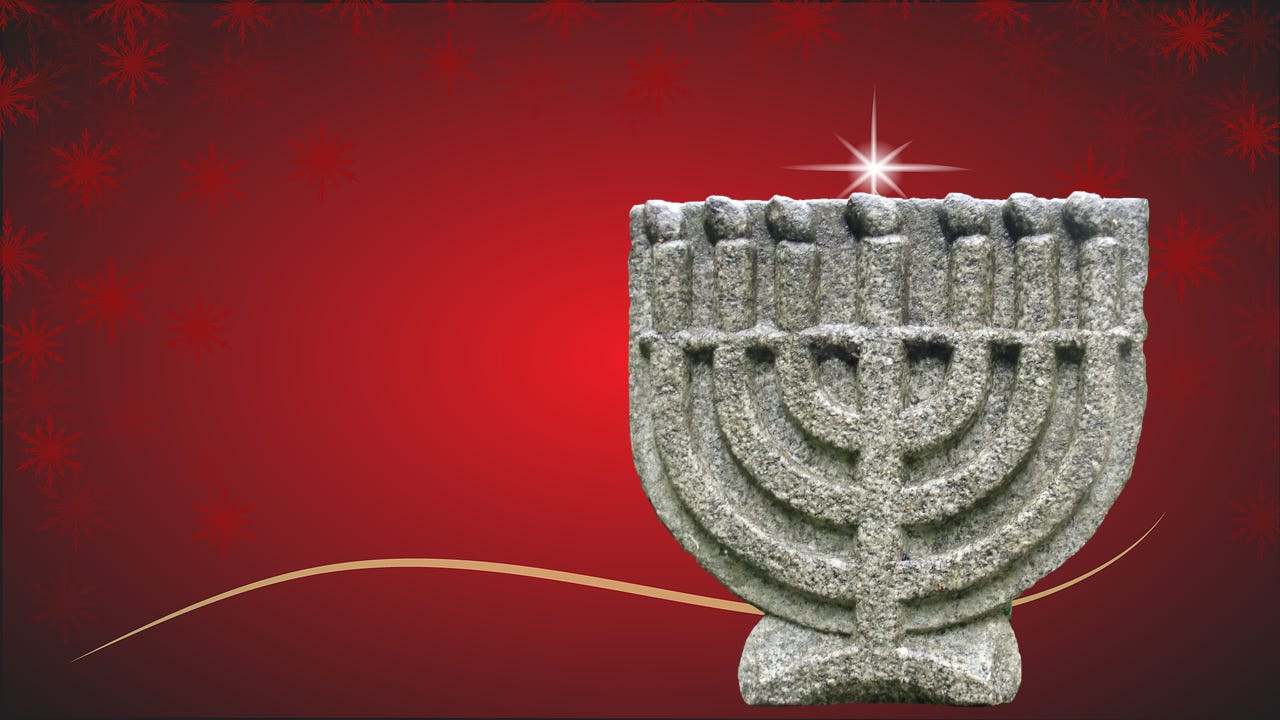
So why should Christians celebrate this holiday along with Christmas?
Well, three reasons:
One, Jesus celebrated Hanukkah (see John 10:22). If Jesus did it, we can too. In fact, maybe we should. He is the reason for the season, after all.
Two, Hanukkah has an apt connection to advent. In advent we prepare and we rededicate ourselves–our temples–to the Lord for the next year and beyond. What better guidance for that rededication than an ancient holiday which Jesus endorsed?
Third, and most importantly, because there is a reason that the ancient Israelites were commanded to feast and make merry. It’s the same reason we ought to make merry for our Christmas celebrations.
Because merry doesn’t mean to laugh like having a bowl full of jelly. That’s a later connotation.
The denotation of the word merry is something more essential and more powerful.
Old English myrge means “Joyful, gladness, exciting feelings of relish.”
This comes from Proto-West Germanic murgī which means “short”.1
There are two ideas here: Joy and shortness.
Joy makes the darker times feel short. We also know from Nehemiah 8:10 that the Joy of the Lord is our strength.
Joy shortens the hard times, and joy gives strength. Joy is the light, the strength, that brings us through dark times. There’s a reason that Hanukkah was also called the festival of lights in Jesus’ day. It’s because it comes at the darkest time of the year for Jerusalem (and for us in the Northern hemisphere, too).
It is in the darkness that light is needed most.
G.K. Chesterton wrote that one way to shorten the long winters is lengthen Christmas. He was correct. The way to deal with hardship is to create more merriness, not less. More joy, not less.
More Christmas, not less.
GK Chesterton wrote that Christmas “is based upon a contrast, a contrast of the fire and wine within the house and the winter and the roaring rains without. It is far more poetical, because there is in it a note of defense, almost of war; a note of being besieged by the snow and hail; of making merry in the belly of a fort.”
The Maccabees were doing literally that, making merry in the belly of a fort.
They knew what Chesterton knew. They knew they’d need the joy, the strength and the merriness for all the darkness ahead. Biblical feasts were always meant to be strength against the darkness. That’s one of the reasons God commanded his regular schedule of feasts in the Old Testament (the other reason is prophetic as you can hear about in my Bammerhab episodes in the footnote2)
The Maccabees remembered from Nehemiah rebuilding Jerusalem hundreds of years earlier that merriness was their strength, and they needed that strength to see through this fight against the mad Greek3 King, Antiochus Ephiphanes.
And through many deaths, downturns and darkness, the Maccabees succeeded. Israel was preserved, and the entire nation was rededicated and ready for the arrival of Jesus.
Why shouldn’t Christians celebrate that? The groundwork for the geopoliticial realities of that first Christmas day are found in Hanukkah. The two are part and parcel of one larger story.
Why shouldn’t Christians celebrate that? I know I do! I have my menorah on the ledge near my Christmas tree.
So perhaps, we as Christians might occasionally wish each other a Merry Hanukkah, as a part of our advent celebrations, and perhaps we too could also light candles alongside our Jewish neighbors.
After all, when you’re wishing someone a Merry Hanukkah, you’re really wishing each other to take strength in the joy of the Lord, to take heart in the darkness, to hold fast and never back down in the face of evil armies everywhere.
So in that spirit, I wish all a Merry Hanukkah, and to all a good night!

“Being happy is not so important as having a jolly time. Philosophers are happy; saints have a jolly time. The important thing in life is not to keep a steady stream of pleasure and composure (which can be done quite well by hardening one’s heart or thickening one’s head), but to keep alive in oneself the immortal power of astonishment and laughter, and a kind of young reverence. This is why religion always insists on special days like Christmas… it is an uncomfortable comfort. ”
⁃ G.K Chesterton, The Illustrated London News (1907)

For more thoughts why Christians should celebrate Hanukkah, I’d recommend the One for Israel ministry on YouTube.
This comes from Proto-Germanic murguz (“short”) which is cognate with Latin brevis (“short”) and Ancient Greek βραχύς brakhús (“short”).

Antiochus Ephiphanes was culturally Greek, a descendant of Alexander the Great’s general Seleucus. Yet historians call his empire Seleucid, to differentiate it from other Greek empires of that era. However, the Seleucids were ethnically, culturally and in all other ways, very Greek. So to not confuse you, I’m just calling Antiochus Greek, but technically he was Seleucid.
Sorry to be picky, but your picture is of an ordinary menorah. The Hanukkah menorah, or Hannukiah, has nine branches, instead of the usual seven. Hanukkah is in 8-day holiday, and the 9th is used to light the rest.
Great insight! Merry Hanukkah!